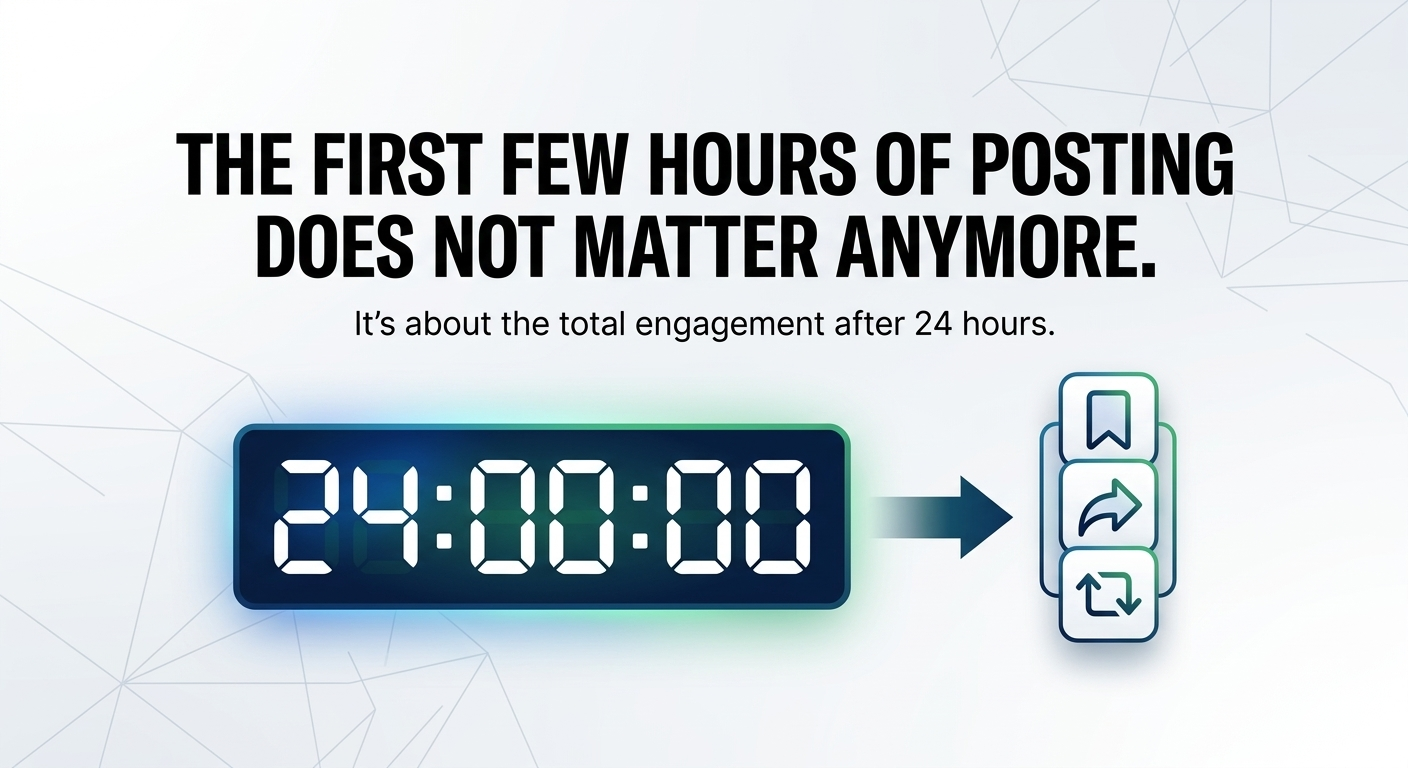
The First Few Hours of Posting Does Not Matter Anymore
Forget the Golden Hour: Why the First Few Hours of Posting Does Not Matter Anymore
For years, social media managers and content creators have lived by a strict, almost religious code: The Golden Hour. We were told that the first 60 minutes after clicking 'publish' determined the lifespan and success of a post. If your content didn't gain immediate traction, it was deemed dead on arrival, buried by the ruthless chronological shadow of the feed.
But social media algorithms have evolved. The landscape has fundamentally shifted. If you are still obsessing over how many likes you receive in the first hour, you are optimizing for an outdated version of the internet.
The truth is, the first few hours of posting does not matter anymore. We are living in the era of the prolonged engagement curve.
Here is why the new rules of social media strategy demand that you stop looking at the one-hour mark and start looking at the 24-hour horizon.
The 24-Hour Halo: The New Benchmark for Success
The most significant shift in modern algorithms—across Instagram, TikTok, Facebook, and LinkedIn—is the move away from recency as the primary ranking signal. Algorithms are now highly sophisticated recommendation engines focused on relevance and sustained interest.
Immediate performance is volatile. A post might start slowly because your audience is at work, driving, or sleeping.
The algorithm now grants a "grace period," often extending past the first 12 hours. It spends this initial phase testing your content against small, diverse segments of your followers and new users. It monitors how these test groups react. If a test group shows strong high-value engagement (which we will define below), the algorithm widens the reach.
This iterative process takes time. Judging a post after two hours is like judging a marathon runner based on their first 100 meters. The only metric that truly reflects a post's potential velocity and staying power is the total number of engagement after 24 hours. This window allows the recommendation engine to complete its initial testing phases and distribute the content effectively.
Engagement Hierarchy: Shares, Saves, and Reposts Are the New Kings
The definition of "engagement" has been rewritten. When algorithms prioritized initial velocity, "vanity metrics" like likes and comments were paramount. They were easy signals.
While still positive, those metrics are no longer sufficient to trigger virality. Comments, surprisingly, are decreasing in algorithmic weight. Why? Because they are too often noise—simple emojis or low-effort "Great post!" replies.
To succeed now, you must optimize for shares, saves, and reposts. These are high-friction, high-value actions that signal deep relevance and utility.
Saves: When a user saves your post, they tell the algorithm, "This content is valuable. I need to reference it later."
Shares (DMs): When a user sends your post to a friend via Direct Message (DM), they are validating your content to another user personally. This is often the highest-weighted organic signal.
Reposts/Retweets: This signal shows a desire to associate their personal brand with your content, giving you external validation.
These high-value actions rarely happen in the first hour. Users often see content, engage passively, and return to save or share it later when they have more focus. A post that accumulates 20 saves over 24 hours will far outperform a post that gets 100 likes in its first hour.
Wait, if Time-of-Posting Doesn't Matter...
Let’s be clear: recency doesn't matter, but your audience's active habits still do.
You should still post when your followers are most likely to be online. If you are targeting professional executives in London, posting at 3 AM GMT is still a poor strategic choice, even with a 24-hour window.
The distinction is this: In the old system, posting at the peak time was the only way to survive. In the new system, posting at the peak time gives the algorithm its first optimal data set. It gives your strongest followers the chance to see it first, perform those critical saves and shares, and effectively kickstart the algorithm’s multi-phase testing process.
Strategic timing facilitates the discovery phase; it no longer guarantees the result.
How to Pivot Your Social Media Strategy
The demise of the "golden hour" means creators must move away from reactive posting toward long-game strategies.
Stop Real-Time Panic: Do not make emotional editing decisions based on a post's performance after one hour. Resist the urge to delete and repost just because it started slowly.
Repurpose for "Saves": Shift your content creation toward high-utility value. Create more "how-to" carousel posts, checklist summaries, or insightful data infographics—content that actively encourages users to "Save for later."
Encourage Sharing: Actively ask your audience (via Call-to-Action) to share the post with someone who needs to hear it, rather than just asking them to "comment below."
Redefine Analytics: Adjust your internal reporting. Evaluate the success of your social media campaigns based on their 24-hour and 7-day totals, not on immediate reaction.
The social media feed is no longer just a timeline of "what’s happening now." It is a curated library of what is interesting, useful, and relevant. To succeed, your content must possess lasting utility, not just immediate noise.