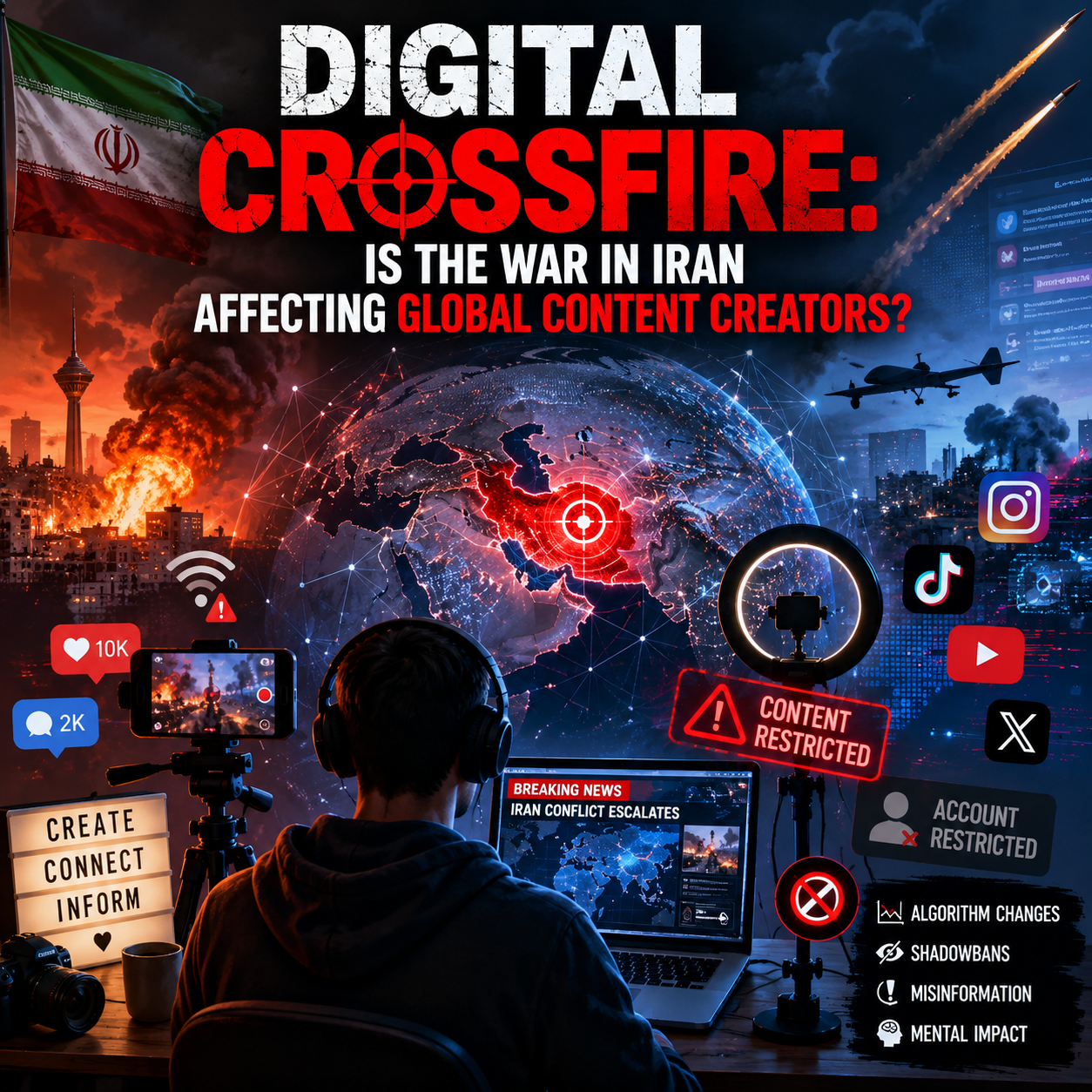
The military escalation involving Iran, the United States, and regional actors has completely upended global geopolitics. While kinetic warfare rightfully dominates international news feeds, a parallel, silent conflict is raging across our digital spaces.
The immediate question facing the digital economy is straightforward: Is this war affecting content creators at all? The short answer is yes, profoundly. However, the nature of that impact depends entirely on where a creator is located, what type of content they produce, and how sensitive platform moderation engines have become. From regional digital blackouts to fundamental policy overhauls by tech giants, the ripple effect is quietly reshaping global reach, distribution metrics, and monetization.
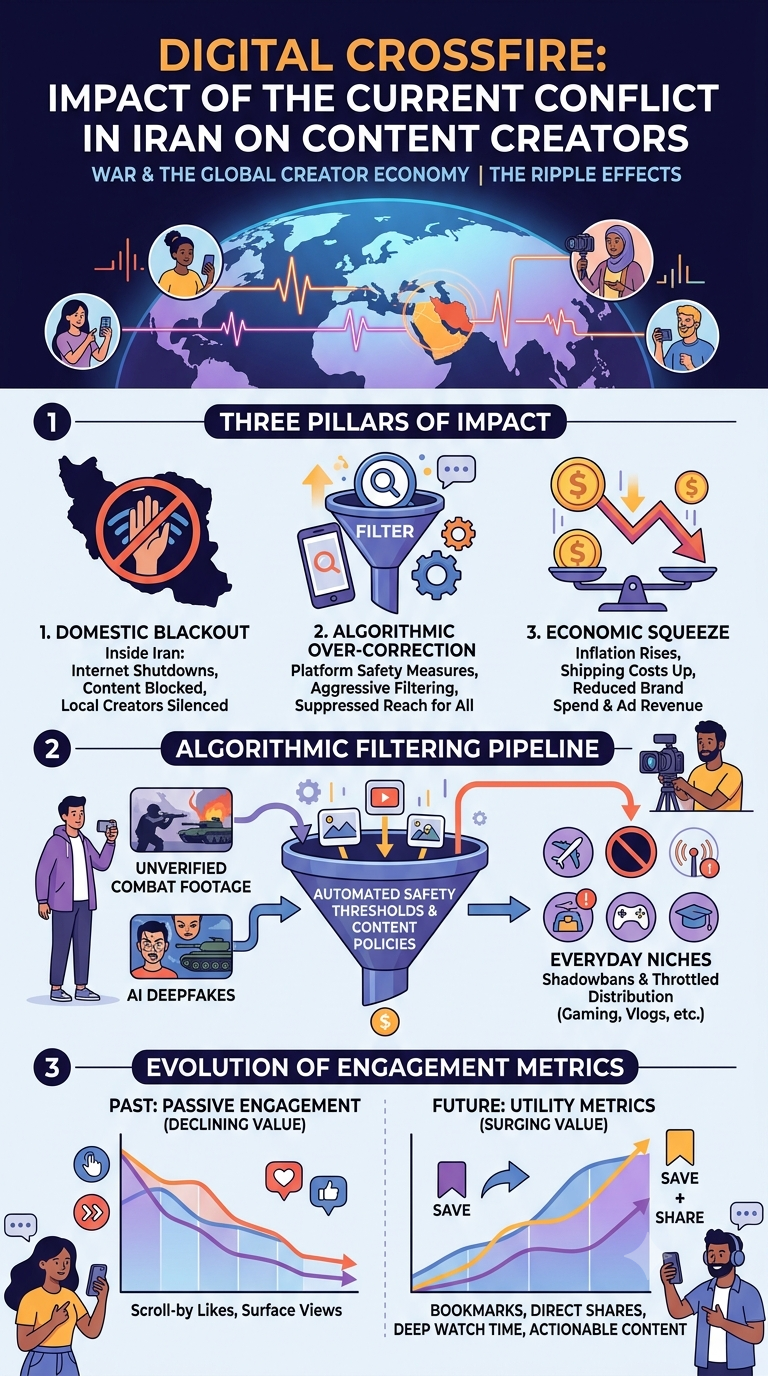
1. The Domestic Blackout & The Diaspora Pipeline
Inside Iran, local content creators have effectively been erased from global platforms. In an immediate effort to control the geopolitical narrative and mask internal infrastructure damage from military strikes, sweeping internet blackouts and severe digital restrictions were deployed. Cut off from global servers, domestic creators can no longer upload, manage channels, or access international ad-revenue protocols.
This enforced silence has triggered an immediate pipeline effect across the broader digital landscape:
The Diaspora Conduit: Iranian diaspora creators in Western markets have suddenly been thrust into the role of primary information interpreters. As search trends queries like "Why are we at war with Iran" spike by thousands of percent globally, accounts providing objective historical context, cultural insights, and policy analysis are experiencing an unprecedented surge in follower acquisition and view duration.
The First-Person Verification Gap: Because international creators cannot easily verify information coming out of the blackout zone, an information vacuum has formed. Creators are walking an exhausting tightrope, balancing immediate anti-war advocacy with deep-seated solidarity for domestic dissident movements, all while fighting highly targeted state-backed reporting campaigns.
2. Algorithmic Over-Correction & The AI Clampdown
For everyday lifestyle, travel, or educational creators who stay entirely clear of geopolitical commentary, the conflict has still radically shifted how algorithms distribute their media. The current war has seen a massive influx of sophisticated AI-generated misinformation, ranging from deepfakes of active aircraft carriers to completely fabricated combat footage rendered from video games.
To prevent these assets from triggering platform liabilities, major distribution systems have aggressively tightened their automated safety filters, causing immense collateral damage:
The 90-Day Structural Penalty: In response to viral, unverified combat footage, major platforms like X (formerly Twitter) have introduced zero-tolerance rules, applying 90-day demonetization penalties to accounts sharing AI-generated images of armed conflict without explicit disclosures.
Hyper-Sensitive Safety Thresholds: Meta, TikTok, and YouTube have significantly adjusted the sensitivity on their automated visual and keyword detection systems. Independent creators worldwide are witnessing severe drops in organic reach and sudden view plateaus simply because an innocent vlog, gaming stream, or history essay mistakenly flagged a hyper-sensitive, war-related moderation safety valve.
3. Macro-Financial Shifts: The Metric Evolution
Beyond lines of code and content policy, the war is creating a tangible economic squeeze across corporate marketing budgets.
The Brand-Safety Retraction: With escalating threats to maritime trade routes driving energy and shipping costs higher, global consumer brands are taking a highly defensive stance. Corporate ad budgets are actively contracting or pivoting toward hyper-conservative, crisis-safe channels. As a direct result, creators globally are observing noticeable declines in high-tier brand sponsorships and a downward trend in standard RPM/CPM ad payouts.
The Transition from Likes to Utility Metrics: With global audiences hyper-focused on real-time news updates, superficial or purely aesthetic content is struggling to maintain historical watch-time benchmarks. On platforms like Instagram and TikTok, the algorithmic reward structure has accelerated its shift away from passive engagement (likes) toward high-utility metrics: saves and shares. To survive the current feed saturation, creators must pivot toward delivering extreme informational value, highly actionable entertainment, or deep analytical utility that audiences feel compelled to bookmark and distribute.
The Bottom Line
The ongoing war has proven that modern geopolitical conflict can no longer be geographically isolated. A kinetic strike in the Middle East instantly triggers a profound code deployment in Silicon Valley. Whether it is a local creator facing complete digital isolation, a diaspora educational channel bearing the weight of a national narrative, or a commercial creator watching their distribution numbers contract due to defensive safety filters, the ripple effects of this conflict are actively rewriting the rules of our global digital economy.