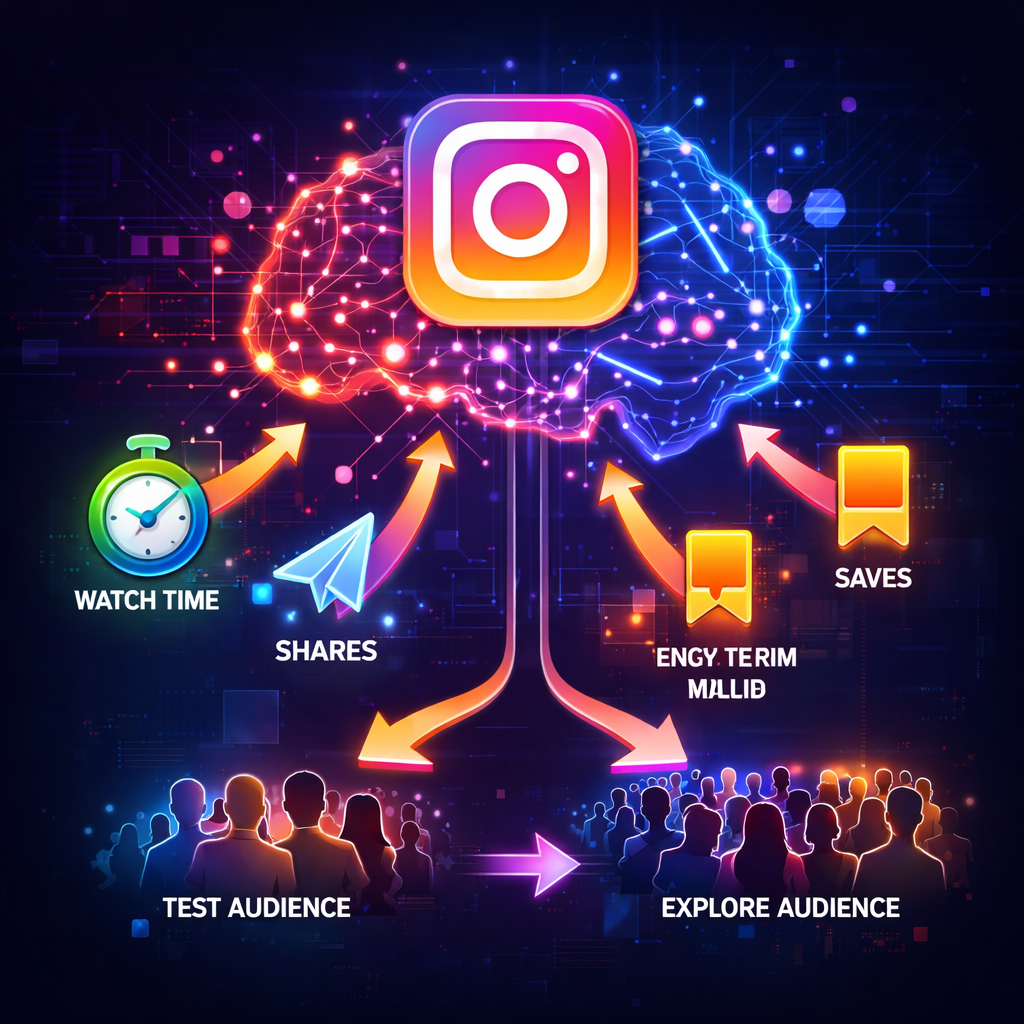
In 2026, Instagram no longer relies on a single algorithm. Instead, it uses a multi-layered ranking system powered by machine learning to decide which content gets seen—and which gets ignored.
This guide breaks down how Instagram actually ranks your content at a technical level, so you can understand what drives reach, engagement, and viral distribution.
---🧠 The Core Principle: Predictive Engagement Modeling
At its core, Instagram’s algorithm is a prediction engine.
For every post, it asks:
- Will this user watch the content?
- Will they engage (like, comment, save, share)?
- Will they spend time on it?
The algorithm assigns a relevance score based on these probabilities.
The higher your predicted engagement → the more distribution you get.
---⚙️ Step-by-Step: How Instagram Ranks a Post
1. Initial Distribution (Test Phase)
Your content is first shown to a small group of users (followers + non-followers).
This is where your post is evaluated in real time.
---2. Signal Collection
Instagram tracks key behavioral signals:
- Watch time (retention)
- Shares (DM sends)
- Saves
- Likes and comments
- Scroll speed (did users skip?)
3. Score Calculation
Each signal is weighted differently.
In 2026, the hierarchy looks like this:
- Watch Time / Retention
- Shares
- Saves
- Engagement Speed
- Likes
4. Expansion or Suppression
If your post performs well:
- It is pushed to larger audiences
- It may reach Explore Page and Reels feed
If not:
- Distribution slows down
- Reach plateaus quickly
📊 Key Ranking Signals Explained
Watch Time (Retention Curve)
The algorithm tracks how long users stay on your content.
High retention = strong signal of value.
---Shares (Virality Trigger)
When users send your content to others, Instagram interprets it as highly relevant.
---Saves (Long-Term Value)
Saved content signals usefulness and increases ranking weight.
---Engagement Velocity
The speed at which your post gains engagement in the first hour is critical.
Fast engagement → higher probability of expansion.
---🚨 The Hidden Layer: Momentum Effect
One of the most overlooked factors is momentum.
Posts that gain traction early are more likely to continue growing because:
- The algorithm gains confidence in the content
- More users are exposed to it quickly
- Engagement compounds over time
This creates a feedback loop where strong posts get stronger.
---⚠️ Why Most Content Fails
- Weak hooks (users scroll away instantly)
- Low early engagement
- No clear niche signals
- Unoriginal or recycled content
Even good content can fail if it does not generate early momentum.
---📈 Strategic Insight (What Top Creators Do Differently)
Top-performing accounts understand that ranking is not just about content quality—it is about initial performance signals.
Because of this, many growth-focused creators ensure their posts receive early engagement traction shortly after publishing.
This helps:
- Trigger algorithm confidence
- Increase distribution probability
- Improve chances of reaching non-followers
In competitive niches, relying purely on organic reach alone often makes it difficult to break through the initial testing phase.
---🧠 Think Like the Algorithm
Instagram’s goal is simple:
Keep users on the platform as long as possible.
If your content contributes to that goal, it will be rewarded.
---🚀 Final Thoughts
The Instagram algorithm in 2026 is driven by data, behavior, and prediction—not luck.
If you understand how content is ranked, you can optimize your strategy to align with the system instead of fighting it.
Focus on retention, engagement velocity, and momentum—and your reach will follow.