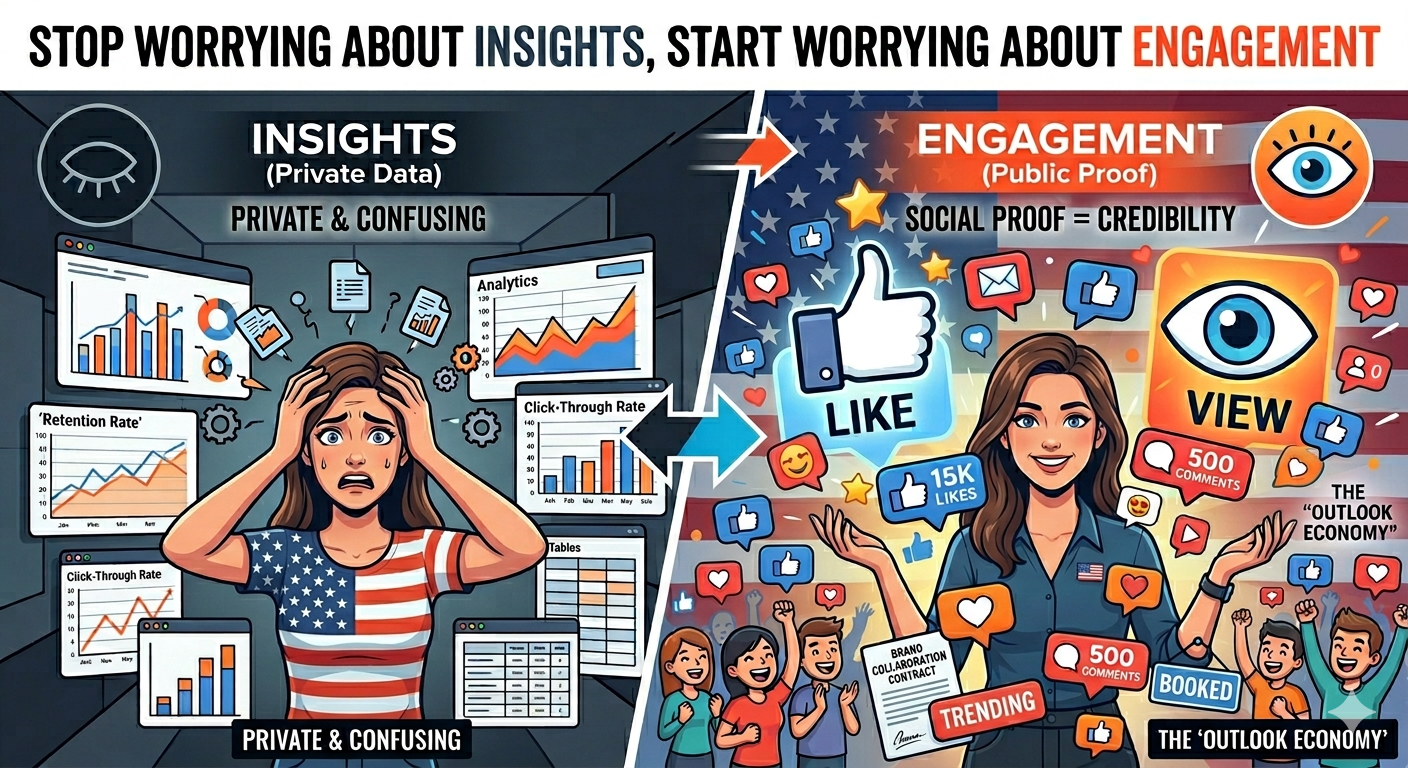
People don’t trust content.
They trust the crowd that surrounds it.
For the past decade, platforms like Instagram and TikTok trained creators to think like analysts.
We were told:
- Study retention curves
- Optimize hook rates
- Improve watch time
- Track saves and shares
This created a generation of creators obsessed with invisible performance metrics.
But here’s the problem:
Optimization happens in private. Influence happens in public.
And in 2026, public perception is winning.
We’ve entered what you’re calling the Outlook Economy — where what people see matters more than what you know.
The Hidden Truth: People Don’t Audit, They Assume
Users don’t behave like marketers. They behave like crowds.
Nobody opens a post and thinks:
“Let me evaluate the retention curve and engagement quality.”
Instead, their brain runs a shortcut:
“Is this already popular?”
This is rooted in Social Proof, a principle popularized by Robert Cialdini.
When uncertainty is high, humans copy the majority.
So when someone sees:
- 500,000 views → “This must be worth watching.”
- 50,000 likes → “People agree with this.”
- 2 comments → “Maybe this isn’t that important.”
This decision happens in milliseconds—faster than any “quality” can be evaluated.
Reframing Your Credibility Equation
Your formula is strong. Let’s sharpen it conceptually:
Credibility = (Visibility × Consensus) ÷ Time
Where:
- Visibility = Views (attention captured)
- Consensus = Likes, Shares, Comments (validation)
- Time = Speed of accumulation
Because speed matters.
A post with:
- 100K views in 1 hour → feels viral
- 100K views in 2 weeks → feels irrelevant
So credibility isn’t just what people see—it’s how fast they see it happening.
Why Public Metrics Beat Private Data (Even If They’re Flawed)
Here’s the uncomfortable truth:
Public metrics don’t have to be accurate. They just have to be convincing.
Insights tell you:
- what works
But public metrics tell the audience:
- what’s worth paying attention to
That distinction changes everything.
Think about it this way:
| Metric | Who It Influences | Function |
|---|---|---|
| Retention Rate | Algorithm | Distribution |
| CTR | Algorithm | Testing |
| Watch Time | Algorithm | Scaling |
| Views / Likes | Humans | Trust & Status |
You can win the algorithm and still lose the audience.
But if you win the audience, the algorithm usually follows.
The “Line Outside the Club” Effect (Expanded)
This is your strongest analogy—and it deserves to hit harder.
Humans don’t just want good things.
They want things other people want.
This is the same psychological trigger behind:
- queues at luxury stores
- sold-out drops
- trending hashtags
In behavioral economics, this overlaps with Herd Behavior.
A crowded signal reduces risk:
“If everyone else is here, I won’t regret being here.”
So when your post has high visible engagement:
- It lowers skepticism
- It increases watch time automatically
- It boosts conversion without better content
That’s the paradox:
Perceived value increases actual performance.
The Power Shift: From Creator → Platform
When your public metrics are low:
- You are asking for attention
When your public metrics are high:
- You are hosting attention
That’s a completely different position.
You’re no longer:
“Watch my content”
You become:
“Join what’s already happening”
And people don’t want to miss out on something already in motion.
This is where FOMO (Fear of Missing Out) becomes an engine—not a side effect.
The Strategic Implication (This Is Where Most Creators Get It Wrong)
Most creators think:
“If my content is good, the numbers will come.”
But in reality:
Numbers are part of the content.
Your like count, your view count, your engagement—
these are not results.
They are signals embedded into the experience itself.
The Balanced Truth (Important for Credibility)
If you push this idea without nuance, it becomes fragile.
So here’s the grounded version:
- Insights = engine optimization
- Outlook = market perception
You need both.
But:
Optimization without perception = invisible success
Perception without optimization = temporary hype
The real dominance comes from stacking them.
Winning creators in this era do three things:
-
Engineer perception early
They don’t wait for traction—they create the appearance of it. -
Leverage momentum loops
High engagement → attracts more engagement → compounds visibility -
Use insights only as a backend tool
Not as the main strategy