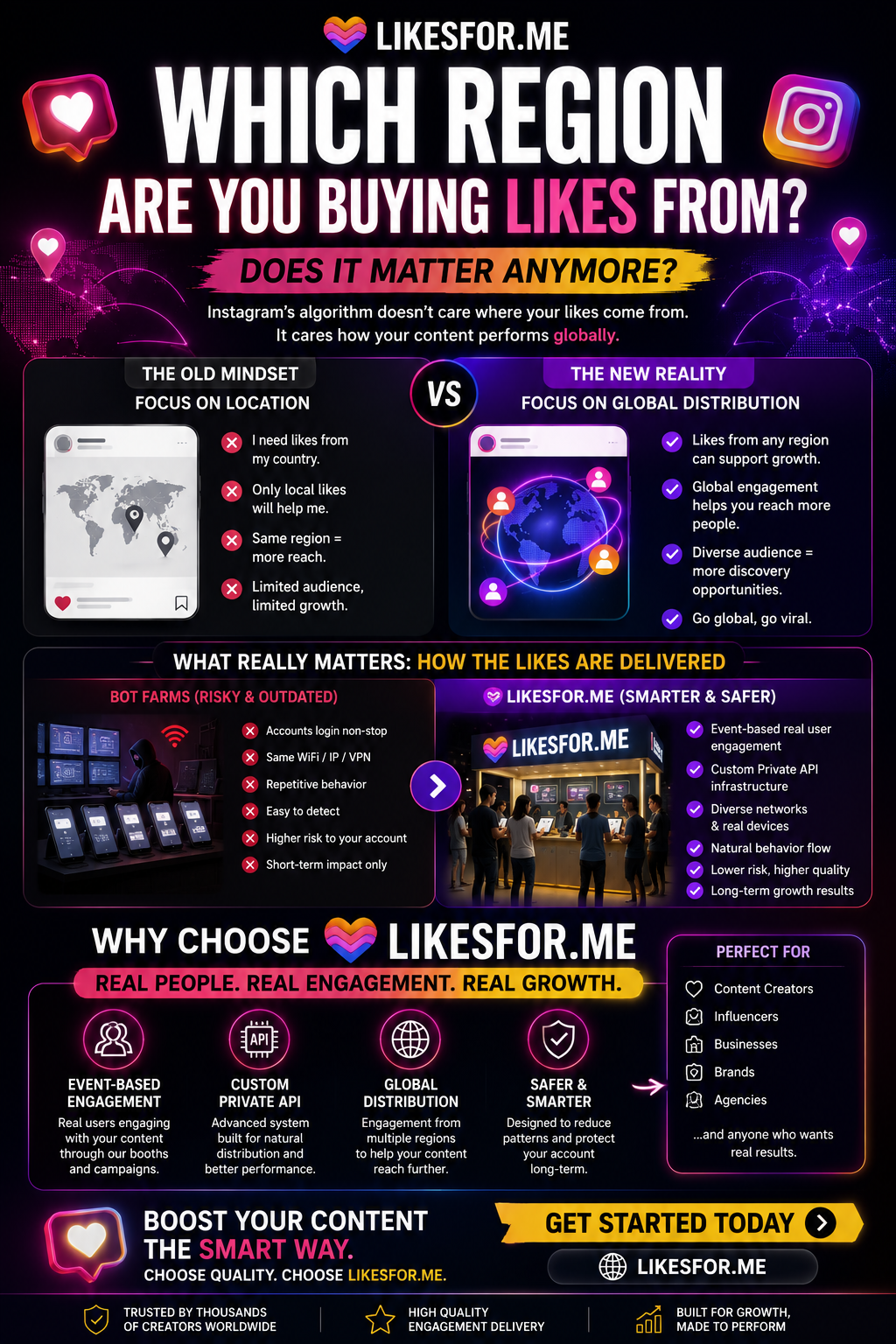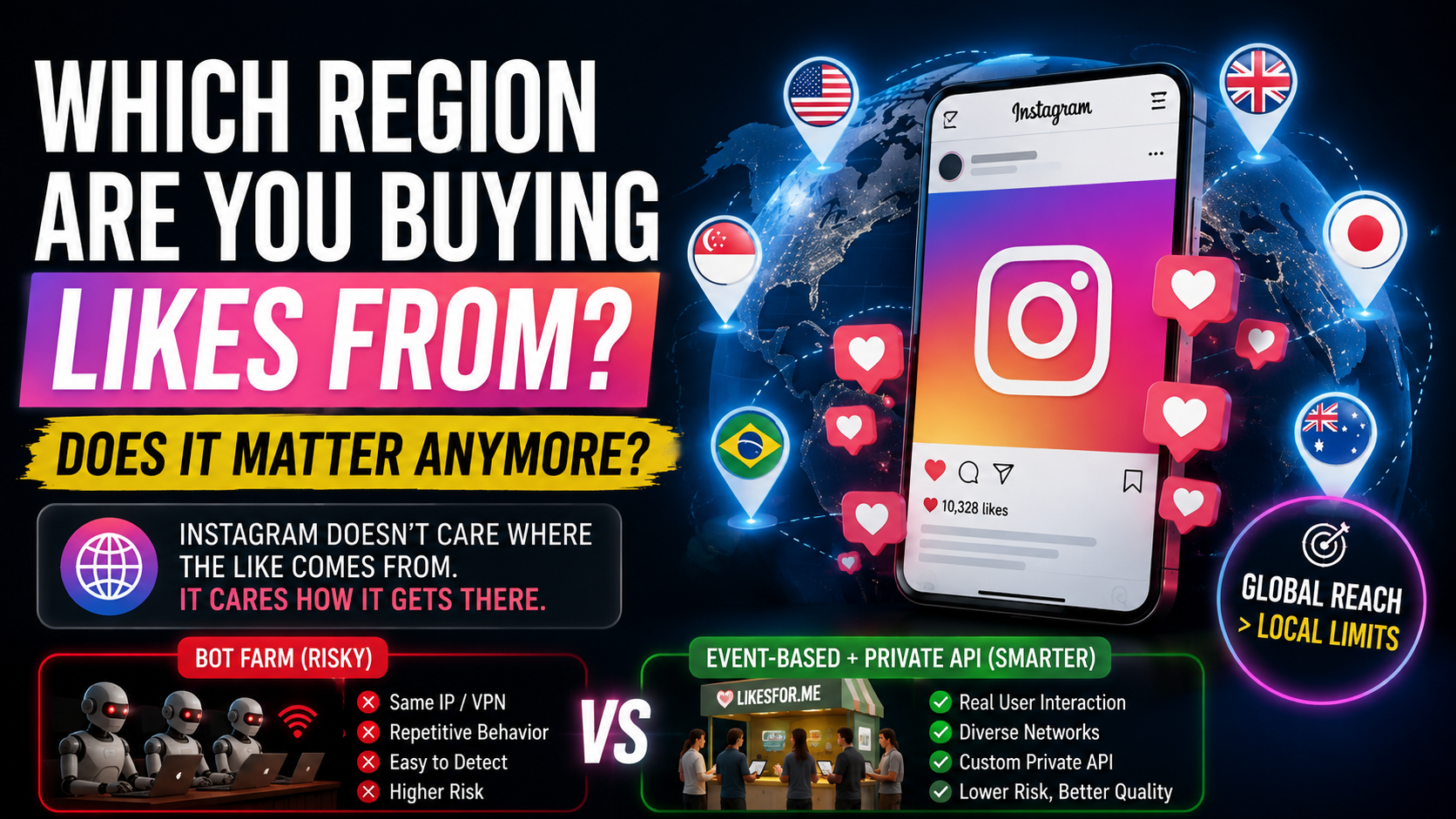
Worldwide engagement beats local likes/views in the eyes of the algorithm.
For years, one of the biggest questions people asked when buying Instagram likes was:
“Which country are the likes coming from?”
Should you buy likes from Singapore? The United States? The United Kingdom? Australia? Thailand? Or somewhere else?
The assumption was simple: if your Instagram account was based in one country, you needed engagement from that same country for the algorithm to take your content seriously.
But Instagram has evolved significantly.
In today's recommendation-driven environment, the country attached to an individual like is far less important than the overall behavior and distribution surrounding the content.
In other words, focusing exclusively on the “region” of your likes can mean looking at the wrong metric.
Does Instagram Only Want Likes From Your Own Country?
Not necessarily.
Instagram is designed to recommend content beyond the creator's existing follower base. Reels, Explore, recommendations, and other discovery surfaces can introduce content to people who may live in completely different countries.
This is particularly important for creators whose content has international appeal.
A travel creator in Singapore might have viewers in Thailand, Malaysia, China, the United States, Europe, and Australia.
A fashion creator might have an audience spread across dozens of countries.
A meme account may have almost no meaningful geographic boundary at all.
So why would an Instagram post necessarily need every engagement signal to come from the creator's home country?
It doesn't.
Going Viral Is About Distribution, Not a Country Label
One of the biggest misconceptions surrounding Instagram growth is that a post becomes viral because it receives engagement from a particular geographic region.
In reality, virality is much more complicated.
Instagram's recommendation systems evaluate many aspects of content and viewer behavior. Depending on the surface and content type, factors such as viewing behavior, interactions, relevance, content information, and audience response can influence whether content continues reaching additional people.
That means the more useful question isn't:
“Are these likes from the right country?”
A better question is:
“Is this content capable of generating interest beyond my existing audience?”
Why Global Engagement Can Make More Sense
If your goal is to reach an international audience, restricting your engagement strategy to one geographic market doesn't necessarily make sense.
Consider a creator who produces content about luxury hotels in Singapore.
Their potential audience isn't limited to people physically living in Singapore. Tourists from Australia, Malaysia, Thailand, China, Japan, Europe, and the United States may all be potential viewers.
The same applies to fashion, beauty, entertainment, travel, food, gaming, and many other categories.
Content with international appeal can naturally have an international audience.
Therefore, the idea that every engagement signal must come from the creator's own country is becoming increasingly outdated.
Local Likes vs Global Likes
There is an important distinction between local targeting and geographic diversity.
If you're a local business trying to attract customers in Singapore, Singapore-based engagement may be more relevant to your business objective.
But if you're a creator trying to maximize international discovery, geographic diversity can make considerably more sense.
Think about the difference:
- Local business: Relevance to the local market may matter more.
- Travel creator: An international audience may be highly relevant.
- Fashion creator: Potential viewers can come from almost anywhere.
- Entertainment creator: Geographic boundaries may be relatively weak.
- Global brand: Multiple markets may be relevant simultaneously.
There is no universal “best country” for Instagram likes.
But There Is a Much Bigger Question: How Are the Likes Being Generated?
This is where the discussion becomes much more interesting.
Two services could both advertise “10,000 Instagram likes,” while the underlying delivery mechanisms are completely different.
Simply knowing the geographic label attached to those likes doesn't tell you how the engagement was generated.
A provider could potentially use automated accounts, repetitive network infrastructure, proxy services, or other automated systems.
Another provider could use a completely different distribution model involving real users interacting with content through controlled campaigns or event-based systems.
The number of likes may look identical on the surface. The underlying activity is not necessarily identical.
Why “Bot Farm” and “Region” Are Two Different Conversations
A common misconception is that buying likes from a particular country automatically makes the engagement higher quality.
It doesn't.
A bot-generated account doesn't become more authentic simply because the account is associated with the United States, Singapore, or another country.
Geographic origin and account behavior are separate issues.
If a large number of automated accounts repeatedly perform similar actions, the geographic label alone doesn't change the underlying behavior.
This is why obsessing over whether your likes are “US,” “UK,” “Singapore,” or “Thailand” can miss the bigger picture.
What About Event-Based Engagement?
Another approach is to distribute engagement through event-based campaigns rather than relying entirely on automated account farms.
At LikesFor.me, for example, our model includes event-based booths and a customized private API infrastructure designed around controlled engagement distribution rather than simply having one automated account repeatedly logging in and performing actions.
The important distinction is not the country printed on a service description.
It is how the engagement is actually being generated and distributed.
However, no third-party engagement method should be described as “undetectable” or guaranteed to be safe from platform enforcement. Instagram can change its systems and policies at any time.
Does This Mean Region Doesn't Matter At All?
Not exactly.
Geographic information can still be relevant to Instagram's understanding of content and audiences. Location can also matter enormously for businesses, local creators, events, and geographically specific content.
But that's very different from saying:
“You must get likes from your own country to go viral.”
There is no reason to treat that as a universal rule.
If your content is designed for a global audience, international engagement can be perfectly logical because your potential audience is global in the first place.
Going Global Can Be More Important Than Going Local
For creators targeting international discovery, the objective shouldn't necessarily be to make every signal look geographically identical.
Instead, think about the audience you actually want to reach.
If your content has universal appeal, people from different countries can discover, watch, share, and interact with it.
That's one of the fundamental characteristics of modern short-form content platforms:
Good content can travel.
A Reel created in Singapore can be watched in London. A fashion video created in Bangkok can reach viewers in New York. A food video from Tokyo can attract viewers in Australia.
The internet doesn't stop at national borders — and neither does Instagram's potential audience.
So, Which Region Should You Buy Likes From?
If you're asking this question purely from the perspective of Instagram's ability to recommend content, the answer is:
There isn't one magic region.
Your content's subject matter, audience, relevance, viewing behavior, interactions, and overall distribution are much more important considerations than simply choosing a country from a dropdown menu.
If your target audience is global, there's no fundamental reason to believe that engagement must come exclusively from your home country.
And if you're evaluating a third-party engagement service, don't stop at asking:
“Where are the likes from?”
Ask the more important questions:
- How is the engagement generated?
- How is activity distributed?
- Is the service relying heavily on automated accounts?
- Is there a repetitive account or network pattern?
- Does the provider explain how its delivery system works?
- Is the engagement appropriate for the audience you're trying to reach?
The Bottom Line
The old obsession with finding the “perfect country” for Instagram likes is becoming less useful.
Region alone does not make engagement valuable.
For creators pursuing international reach, engagement from a broader audience can make more sense than artificially restricting activity to one country.
More importantly, the way engagement is generated matters far more than the geographic label attached to it.
So instead of asking:
“Which region should I buy likes from?”
Ask:
“What kind of audience am I trying to reach, and how is the engagement actually being generated?”
In a global, recommendation-driven Instagram environment, thinking beyond borders may be far more useful than trying to find the “perfect” country.