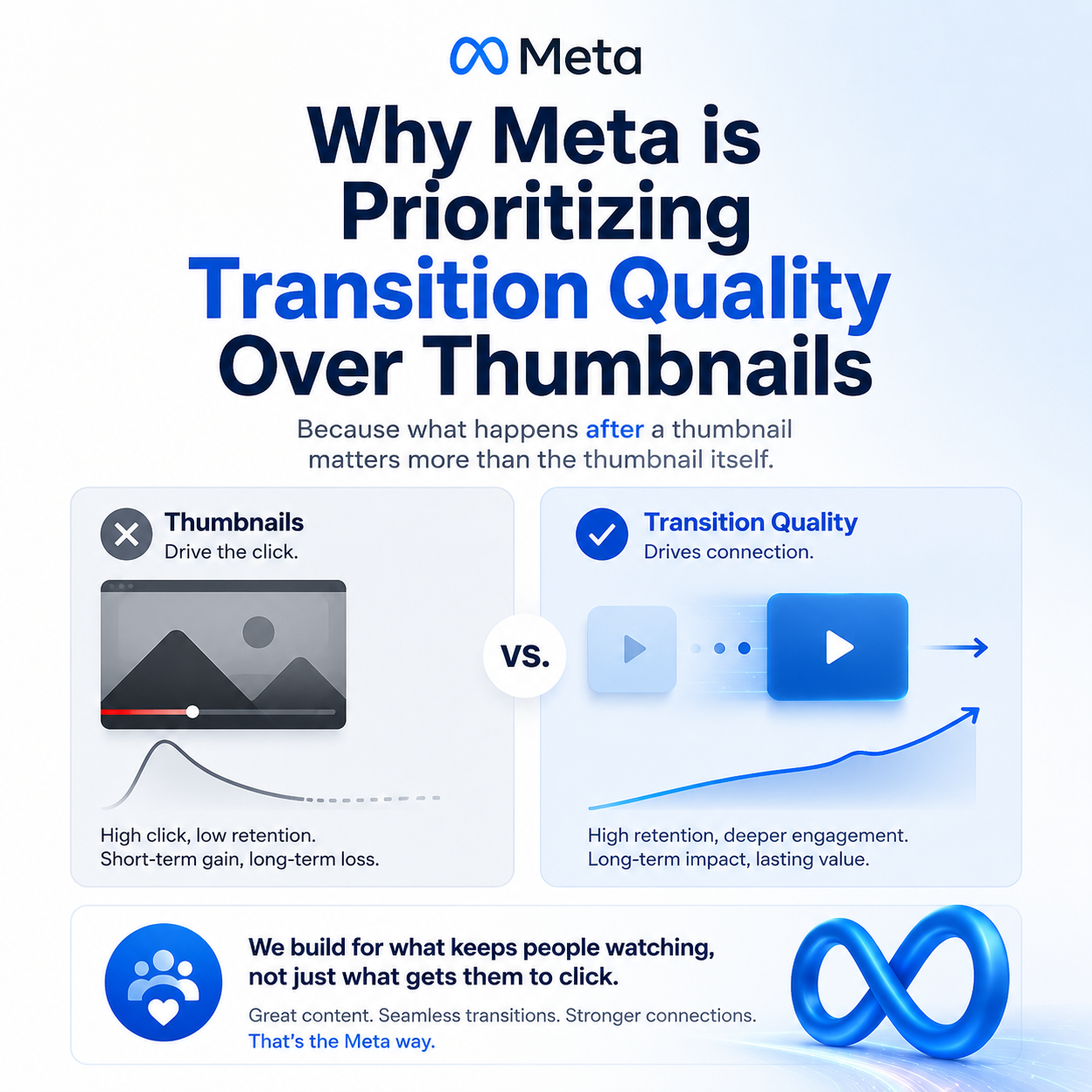
Why Meta is Prioritizing Transition Quality Over Thumbnails
For the better part of a decade, digital marketers, content creators, and media buyers have operated under a single, golden rule of short-form video: win the first frame. The thumbnail—whether an intentionally staged, high-contrast cover image or a carefully selected, expressive freeze-frame with bold text—was treated as the ultimate metric driver. It was the "scroll-stopper," the tool engineered to juice Click-Through Rates (CTR).
However, a fundamental structural shift is occurring deep within Meta’s machine-learning infrastructure. Driven by major algorithm overhauls (including the deep integration of cross-surface architecture and generative recommendation models), the static thumbnail is losing its leverage.
Meta's next major frontier for content evaluation isn't how well an asset gets someone to stop scrolling; it's how seamlessly it keeps them moving. The platform is shifting engineering priorities toward transition quality and contextual sequence learning, fundamentally rewriting the blueprint for organic and paid video distribution across Instagram Reels and Facebook.
1. The Thumbnail Paradox: How AI Replaced Click-Through with Hold Rate
The decline of the traditional thumbnail is directly tied to how Meta’s AI now understands user satisfaction. Historically, video recommendation engines operated on immediate feedback loops: a user saw a thumbnail, clicked it, and that action counted as a positive distribution signal.
This created a systemic issue across the platform's feeds: clickbait. High-CTR thumbnails frequently fronted low-retention videos. To counter this, Meta introduced more aggressive retention-based modeling. With recent updates, sequence-learning models heavily prioritize deeper intent metrics: watch time, completion rate, saves, and direct message (DM) shares.
If a highly optimized thumbnail spikes the initial CTR but the viewer bounces within the first two seconds, the algorithm flags the asset as jarring or irrelevant. Under current creative-delivery logic, the creative is the targeting mechanism. The algorithm literally "watches" the video to see who stays. A flashy thumbnail that fails to seamlessly bridge into the video's actual content creates a retention drop-off that chokes distribution.
2. The Mechanics of Transition Quality: The "Zero-Second Emulsion"
If the thumbnail gets the user to pause, the transition quality dictates whether they convert into an engaged viewer. In modern algorithmic terms, transition quality does not mean complex, over-edited Hollywood visual effects. Instead, it refers to the visual, audio, and narrative fluidity between distinct clips—most notably, the transition from the static preview frame to the active video.
Meta is actively training its models to reward what engineers call a Zero-Second Emulsion:
Eliminating Cognitive Friction: When a user clicks a video or pauses on a Reel, any immediate layout shift, abrupt jump cut, or mismatched audio cue causes a spike in immediate abandonment. High transition quality means the visual promise of the first frame flows natively into the action of the next without a jarring break.
Pacing and Rhythmic Flow: Meta continues to refine its native editing tools within Instagram and Facebook, giving creators precise control over transition pacing. This is an explicit signal from the platform: the rhythm of content delivery is a primary metric of creative quality. Clips must merge fast enough to satisfy human attention spans (typically shifting visual information every 1.5 to 3 seconds) but smoothly enough to preserve narrative comprehension.
Text and Overlay Opacity: Fluid transitions also apply to graphic elements. Jarring, bright text blocks that flash instantly on screen are being replaced by smoother asset fades and subtle opacity transitions, preventing visual fatigue as the user transitions deeper into the video timeline.
3. The Technical Catalyst: Multi-Format Automation & Sequence Learning
The prioritize-transitions-over-thumbnails mandate is also a byproduct of technical necessity on Meta’s backend. Through systems like Advantage+ placements and automated asset generation, Meta dynamically transforms a single video file to fit various mobile aspects:
                  ┌──► 9:16 Reels & Stories (Full Vertical)
                  │
[Single Video] ───┼──► 4:5 Mobile Feed (Compressed Vertical)
                  │
                  └──► 1:1 Desktop / Instagram Grid (Square)
Because Meta automatically crops, resizes, and masks video assets depending on where they appear, a custom static thumbnail is highly vulnerable. A title card perfectly composed for a 9:16 Reel may have its text cut off in a 4:5 Feed placement or blocked entirely by native UI overlays (like usernames, captions, and engagement buttons).
Conversely, internal transition quality, pacing, and sequential rhythm remain completely unchanged across all placements. The system analyzes how information is revealed step-by-step. The algorithm favors video assets that maintain a smooth, internal narrative momentum because those files can be confidently distributed across any placement without breaking the user experience.
4. The Content Strategy Blueprint: Thumbnails vs. Transitions
To maximize distribution under Meta's current creative-first delivery architecture, production resources must shift away from static graphic design and toward structural editing flow.
| Optimization Attribute | Traditional Strategy (Thumbnail-Heavy) | Next-Gen Strategy (Transition-Heavy) |
| Primary Algorithm Signal | Immediate Click-Through Rate (CTR) | Hook Rate (3-Sec Views) & Retention Curve |
| Creative Mechanism | High-contrast static text, expressive faces | Native movement, seamless visual bridges, rhythmic cuts |
| Editing Priority | Staging a perfect cover frame | Perfecting the first 3 to 5 seconds of continuous playback |
| Platform Versatility | Poor; text overlays frequently conflict with shifting UI placements | Excellent; internal narrative rhythm remains intact across all formats |
| Audience Alignment | Prone to accidental clickbait and bounce penalties | Aligns with Meta's sequence-learning and True Interest models |
5. Implementation: Engineering the Perfect Video Hook
To align your production workflow with Meta's focus on transition quality, think of your video edit as an uninterrupted flow of visual momentum rather than a series of disconnected clips.
Step 1: The Visual Anchor (0.0s - 0.5s)
Do not use a separate, detached graphic file as your cover. The opening half-second must feature an active visual anchor already in motion—such as a subject moving into the frame or a dynamic point-of-view (POV) angle. If you use a text overlay, ensure it uses a native, clean font with soft opacity padding so it doesn't feel like an invasive advertisement.
Step 2: The Soft Bridge (0.5s - 1.5s)
Instead of hard cuts that force the eye to completely re-adjust, use physical camera momentum (like pan matches or zooming in on a subject) or subtle graphical wipes to execute your first transition. The audio must lead the visual; an audio cue or voiceover line starting a fraction of a second before the visual cut acts as a psychological bridge that pulls the user through the transition.
Step 3: The Pattern Interrupt (1.5s - 3.0s)
Once the user passes the initial bridge, introduce a thematic pattern interrupt—a change in tight b-roll, a text reveal timed to a beat, or a subtle sound effect. This rewards the user’s attention span and resets their mental fatigue timer, drastically increasing the probability that they will stay for the entire duration of the video.
Ultimately, Meta’s engineering updates are forcing a return to core cinematic storytelling: your content is only as strong as its weakest link. A beautiful thumbnail might get a viewer to look at the platform, but it is the quality of your transitions that keeps them on board for the ride.