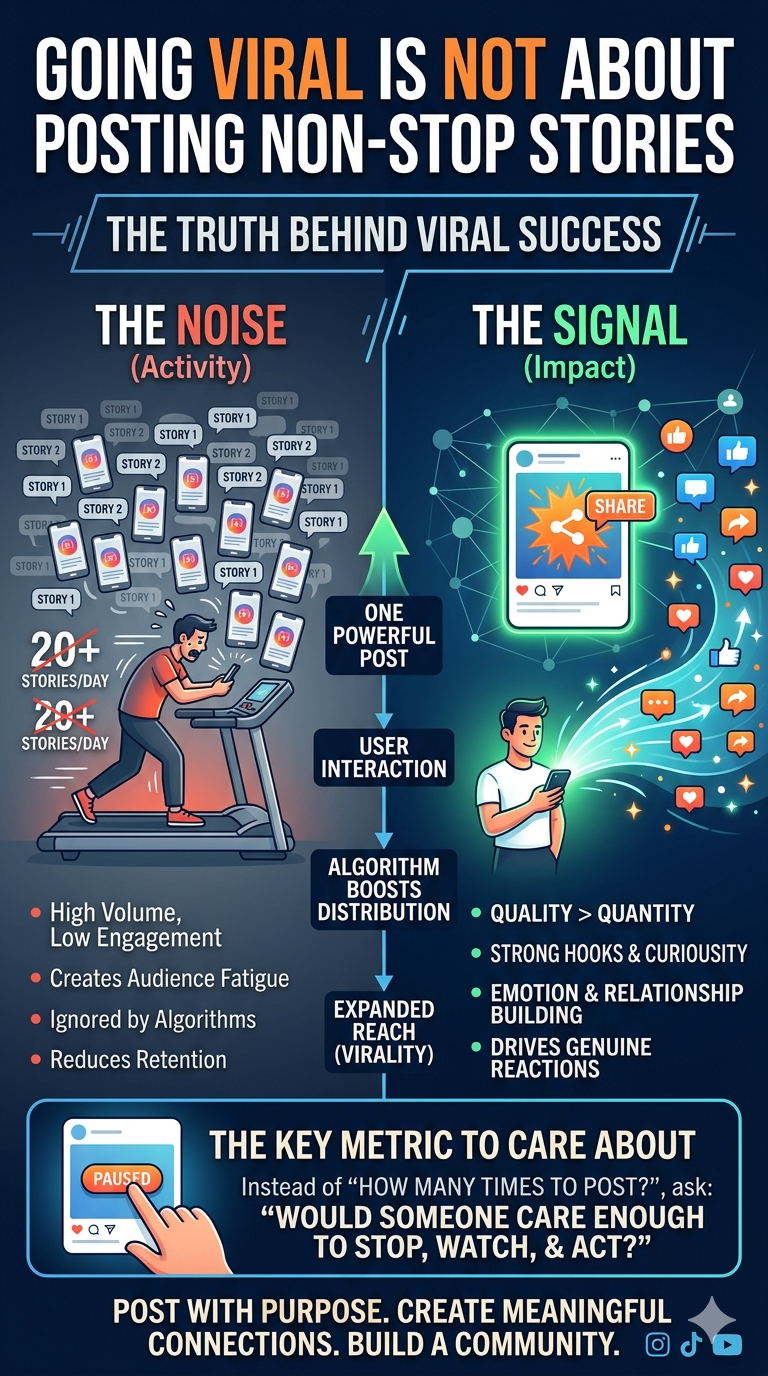
Going Viral Is Not About Posting Non-Stop Stories
There’s a common belief among creators that the more you post—especially Stories—the higher your chances of going viral. It feels logical: more content equals more visibility, right? Not exactly.
The truth is, going viral has very little to do with how often you post, and everything to do with how people react when you do.
Attention > Activity
Platforms like Instagram are no longer rewarding sheer activity. They’re engineered to detect attention, retention, and behavioral signals. If you’re posting 20 Stories a day but nobody is tapping, replying, or staying, you’re training the algorithm to ignore you.
On the flip side, one strong post that holds attention—even for a few extra seconds—can outperform a flood of low-impact uploads.
Virality Is a Reaction, Not a Routine
Going viral isn’t something you grind into existence by spamming content. It’s a reaction loop:
- Someone stops scrolling
- They engage (like, comment, share, profile visit)
- The platform expands distribution
- More people repeat the behavior
That loop doesn’t start because you posted 15 Stories. It starts because one piece of content triggered curiosity or emotion.
Stories ≠ Discovery Engine
Stories are powerful—but mostly for nurturing your existing audience, not reaching new ones.
Think of Stories as:
- Relationship builders
- Trust reinforcers
- Retention tools
Not as your primary virality driver.
If your goal is growth, your focus should shift toward:
- Scroll-stopping posts
- Strong hooks in the first 2 seconds
- Content that invites interaction
The "Algorithm Fatigue" Tax
When you post non-stop, you aren’t just shouting into a void; you might be actively digging a hole. Every piece of content you post acts as a data point for the platform.
The Negative Signal: If a follower swipes past your first three Stories, the algorithm assumes your content is no longer relevant to them. It stops pushing your Stories to the front of their tray.
The Dilution Effect: High frequency often leads to "content thinning." When you're forced to produce 20 updates, the stakes for each one drop. Your audience learns that your content is "skippable," which destroys your Retention Score.
Stories: The "Living Room" vs. The "Billboard"
To understand virality, you must distinguish between Discovery and Retention surfaces.
Reels/TikToks/Main Feed (The Billboard): These are designed for strangers. Virality happens here because the algorithm "tests" the content on people who don't know you.
Stories (The Living Room): These are for your friends and fans. Stories have almost zero "organic reach" to new audiences.
The Strategy: Use Feed posts to grab the attention of the world (Virality), and use Stories to turn that temporary attention into a permanent community. Using Stories to try and go viral is like trying to advertise your business by only talking to people who are already inside your shop.
The Mechanics of "The Hook"
You mentioned that virality is a reaction. In technical terms, this is often driven by High-Velocity Engagement.
The platform doesn't care if a post gets 1,000 likes over a week; it cares if it gets 100 likes in the first 10 minutes. To achieve this, you need a "Hook Strategy":
Visual Tension: Something in the frame that looks "off" or intriguing.
The Open Loop: Starting with a statement that requires a conclusion (e.g., "I found the one thing that stops burnout, and it isn't sleep.")
Low Friction: Making it incredibly easy for someone to react. One "Poll" sticker on a Story is worth more for your visibility than ten text-only slides.
4. Quality is a Metric, Not an Opinion
Creators often confuse "High Quality" with "High Production Value."
High Production: 4K cameras, perfect lighting, professional editing.
High Quality (The Viral Driver): High relevance, high relatability, or high utility.
A shaky, 10-second lo-fi video of a relatable moment will go viral over a $10,000 produced ad every single time because the Human Signal (sharing and saving) is higher.
The New Hierarchy of Content
If you want to grow, stop managing your "Activity Log" and start managing these three metrics in order of importance:
| Metric | Why it Matters | Role in Virality |
| Saves/Shares | Signals "High Value" | The primary driver for the algorithm to "boost" reach. |
| Watch Time | Signals "High Interest" | Keeps the platform happy by keeping users on the app. |
| Comments | Signals "Community" | Creates a feedback loop that pushes you higher in feeds. |
| Likes | Signals "Approval" | The weakest signal; easily given, easily forgotten. |
Summary
If you are posting because the "calendar says so," you are working for the platform. If you are posting because you have a specific "hook" that triggers a reaction, the platform works for you.
One "Save-worthy" post per week will always out-earn 50 "Skip-worthy" Stories. Going Viral Is Not About Posting Non-Stop Stories