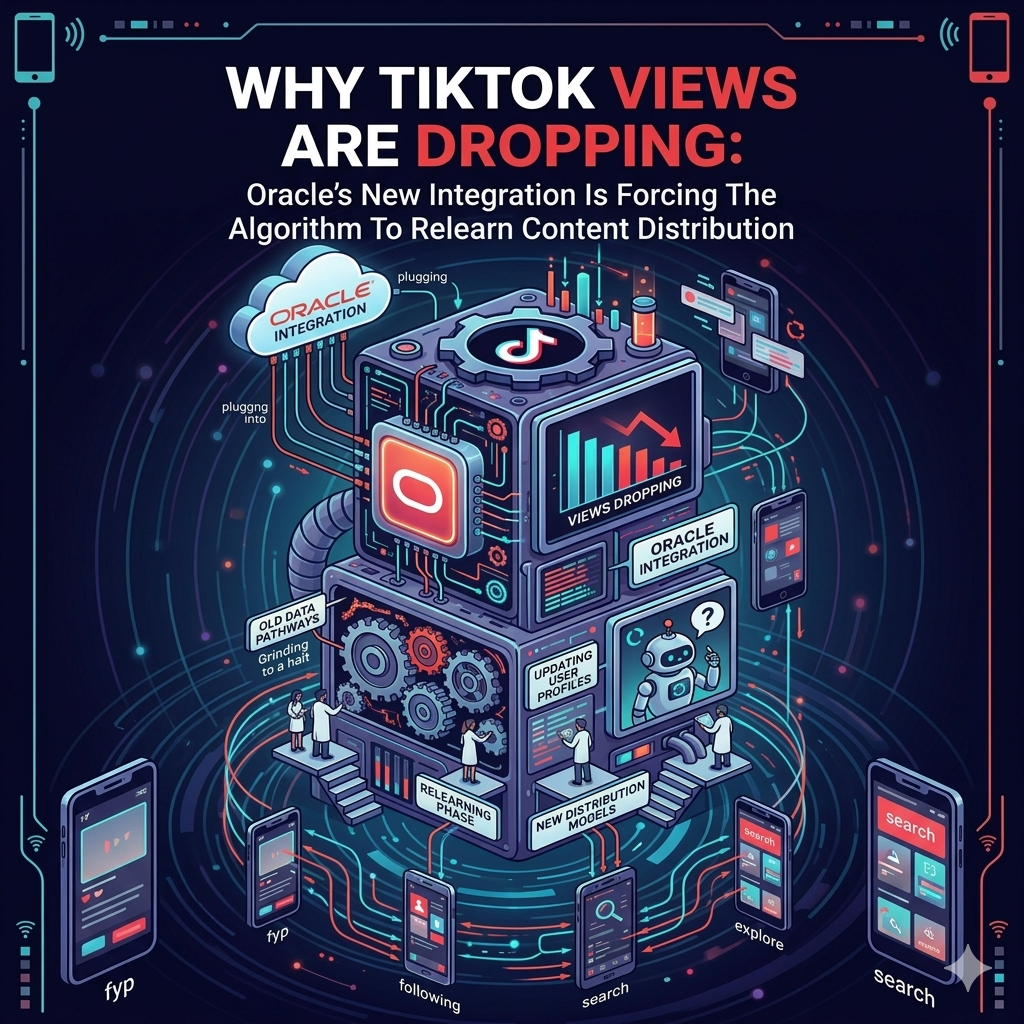
Why TikTok Views Are Dropping: Oracle’s New Integration Is Forcing The Algorithm To Relearn Content Distribution
Over the past few weeks, many TikTok creators, agencies, and growth teams have noticed a sharp and unusual decline in views across multiple niches. Videos that would normally perform consistently are suddenly underperforming, while random uploads experience unpredictable spikes without clear patterns.
A major reason behind this instability appears to be the ongoing infrastructure and data synchronization changes tied to ByteDance’s newer Oracle-based integrations and backend restructuring.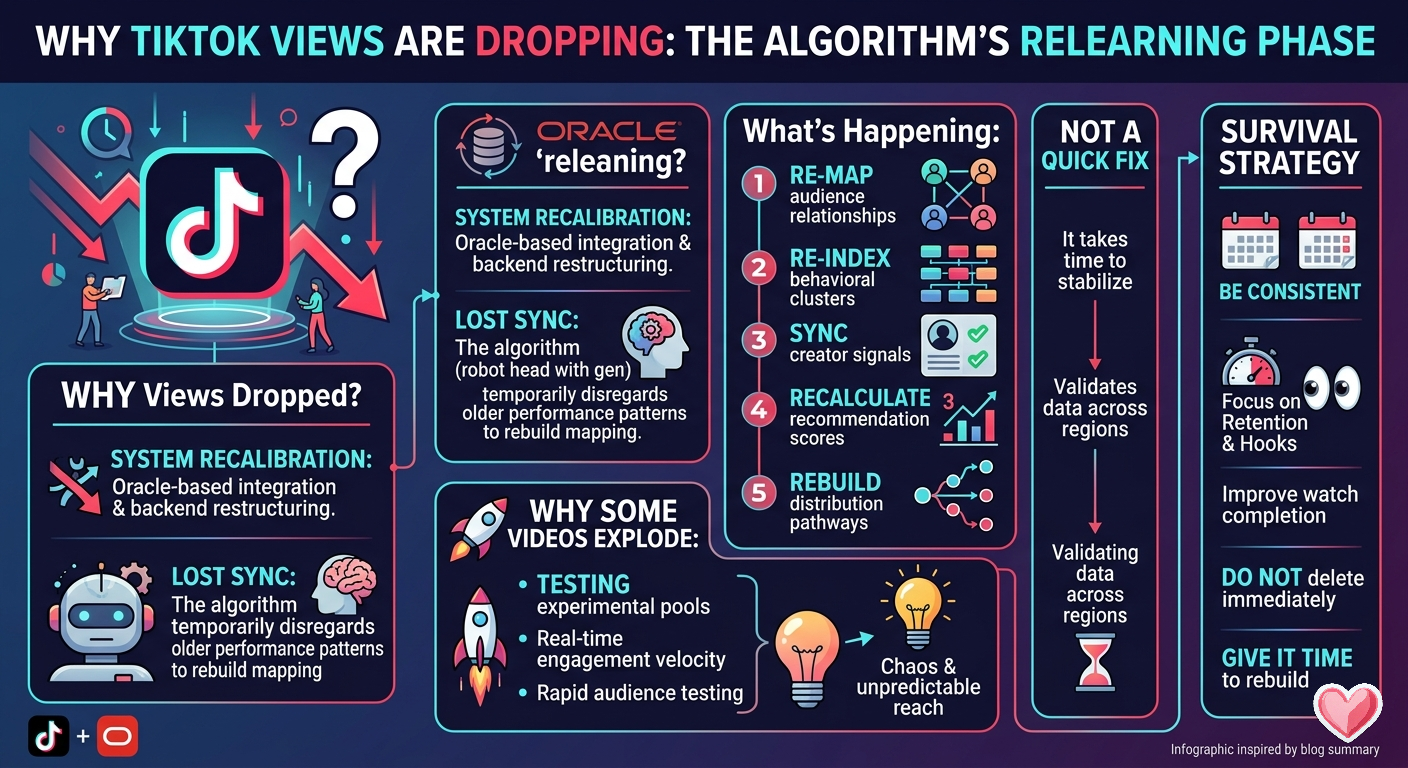
The Algorithm Is Essentially “Relearning” Distribution
TikTok’s recommendation system heavily depends on historical behavioral data. Every creator account develops a performance profile over time based on:
- Watch time patterns
- Audience retention
- Geographic behavior
- Device interactions
- Interest clustering
- Engagement history
- Content categorization
- Session behavior
Normally, the algorithm uses this historical data to predict which users are most likely to engage with a video within seconds of upload.
However, when large-scale backend migrations or infrastructure integrations happen — especially involving cloud databases and regional content distribution systems — those predictive models can temporarily lose synchronization.
This creates a situation where the recommendation engine begins partially disregarding older performance patterns while attempting to rebuild new behavioral mapping structures.
As a result:
- Previous viral consistency becomes unreliable
- Strong-performing accounts suddenly lose momentum
- Content distribution becomes unstable
- View counts fluctuate aggressively
- Audience matching becomes delayed or inaccurate
Why Views Are Dropping So Drastically
The biggest issue is not necessarily that content is “bad.”
The issue is that the system currently appears to be struggling with timing and synchronization between old behavioral datasets and newly integrated infrastructure layers.
TikTok’s algorithm operates at enormous scale. Billions of engagement signals are processed continuously across regions and recommendation pools.
When Oracle-related backend integrations and database imports occur, the system must:
- Re-map audience relationships
- Re-index behavioral clusters
- Synchronize creator trust signals
- Recalculate recommendation confidence scores
- Rebuild content distribution pathways
That process cannot happen instantly.
Even small desynchronizations at this scale can create massive visibility inconsistencies across the platform.
A creator who previously averaged 100,000 views may suddenly struggle to hit 5,000 — not because their audience disappeared, but because the algorithm is temporarily uncertain about where and how aggressively to distribute their content.
Why Some Random Videos Suddenly Explode
Another symptom creators are noticing is the rise of “random virality.”
This happens because the system is currently testing wider experimental distribution pools while rebuilding confidence models.
Instead of relying heavily on historical creator data, TikTok appears to be temporarily placing more emphasis on:
- Real-time engagement velocity
- Immediate retention signals
- Rapid audience testing
- Broader experimental placements
This causes previously predictable performance patterns to become chaotic.
Accounts that once had stable reach now experience inconsistency, while smaller accounts occasionally receive sudden exposure spikes.
This Is Not Something That Can Be Fixed Overnight
Many users assume TikTok can simply “flip a switch” and restore normal performance.
In reality, rebuilding synchronization across massive recommendation databases is an extremely complex engineering process.
The amount of behavioral data TikTok processes daily is enormous. Importing, validating, syncing, and recalibrating those systems across regions takes time.
Any rushed fixes could create:
- Broken recommendation loops
- Duplicate audience mapping
- Incorrect interest targeting
- Engagement inflation issues
- Distribution instability
Because of this, stabilization usually happens gradually rather than instantly.
What Creators Should Expect
During periods like this, creators may notice:
- Lower average views
- Slower initial distribution
- Delayed engagement spikes
- Unpredictable reach
- Higher volatility between uploads
- Sudden performance swings between similar videos
This does not necessarily mean an account is permanently damaged.
In many cases, the algorithm is still recalibrating confidence levels and relearning audience distribution behavior under the updated infrastructure environment.
The Best Strategy Right Now
Creators who survive algorithm transition periods are usually the ones who remain consistent.
Instead of overreacting to temporary drops:
- Continue posting consistently
- Focus on retention quality
- Improve watch completion rates
- Avoid deleting underperforming videos immediately
- Give the system time to rebuild audience mapping
- Prioritize strong hooks and replay value
As the infrastructure stabilizes and recommendation confidence improves, performance patterns are likely to become more predictable again.
At the moment, the volatility itself is one of the clearest signs that the algorithm is still recalibrating.